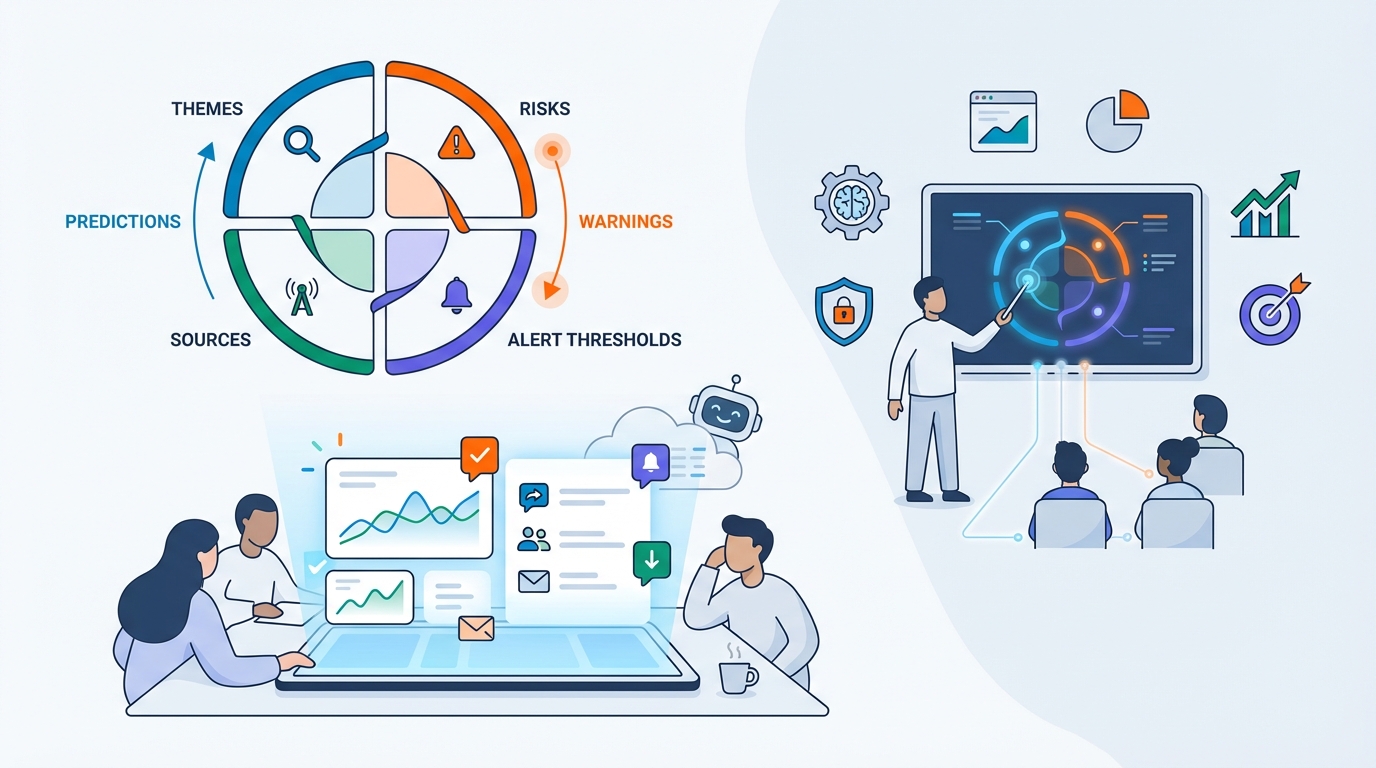
Watch the video
Quick version? Watch the video. For full context, read the article.
AI developments are moving at high speed: product announcements, regulation, security incidents, investments, policy papers, keynotes and earnings calls. The problem is no longer a lack of information — the problem is that signal and noise are mixed together.
Executives, strategists and compliance teams are not looking for endless streams of news. They are looking for one thing:
What is strategically relevant right now, why does it matter, and what evidence supports it?
That is why we are not building a “news platform”, but an AI Radar:
an early-warning intelligence layer that turns developments into verifiable signals with traceable sources and business impact.
From news to signal detection
Instead of collecting or summarising articles, AI Radar is built on three core principles:
-
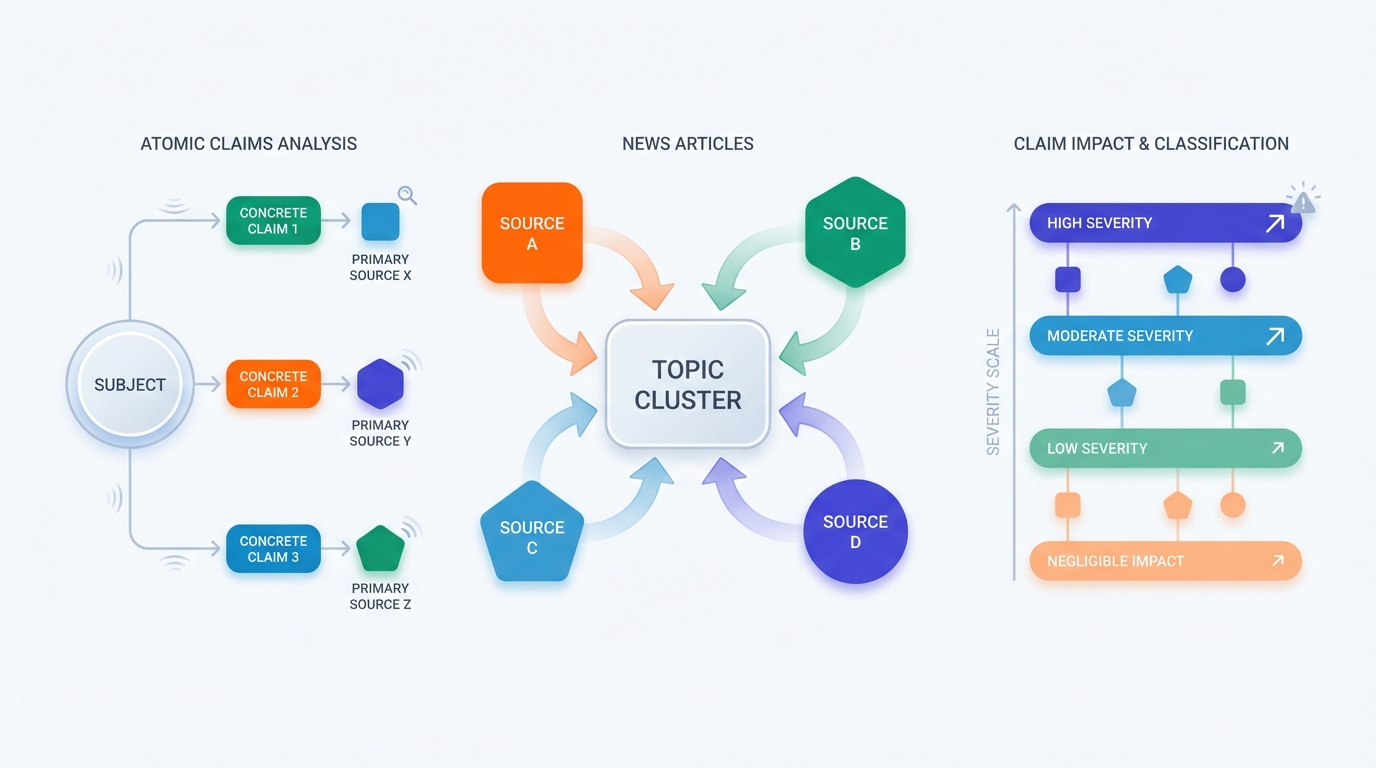
Clustering
Multiple sources about the same topic are grouped into a single subject (no repetition, full context). -
Atomic claims
For each cluster, concrete, checkable statements are distilled:- one claim = one factual assertion
- always traceable to primary sources
-
Impact & classification
Each claim is placed in a strategic context, such as:- Regulation & policy
- Security & risk
- Market & competition
- Cost & infrastructure
- Reputation & governance
The result is not a timeline, but a radar view:
an overview of emerging, confirmed and critical signals.
Evidence layer: trust through traceability
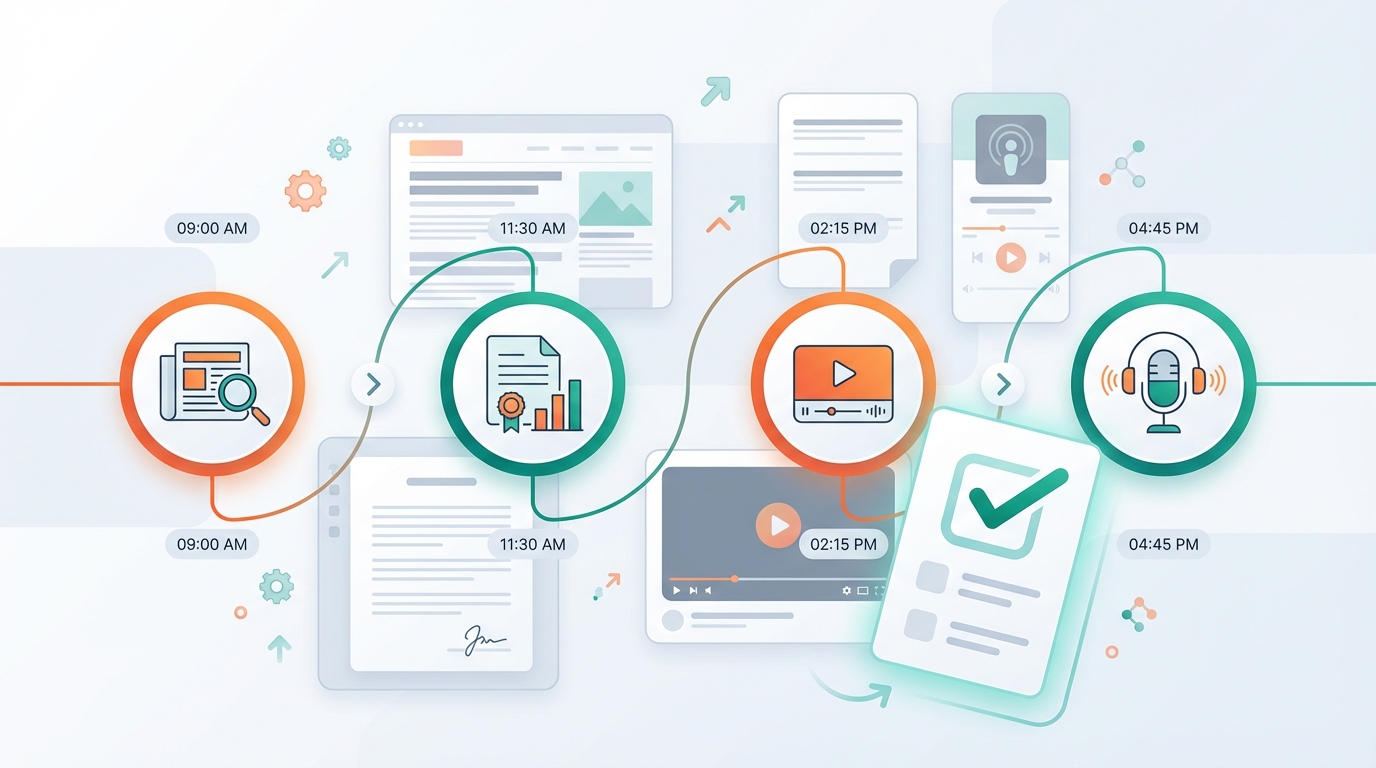
A signal only has value if it can be verified. Every claim therefore includes an evidence layer:
- 📰 News and analysis
- 📄 Policy documents, legislation, filings
- 🎥 Keynotes and hearings (timestamped)
- 🎧 Earnings calls and interviews (transcribed, with time codes)
Videos and podcasts are not presented as “content types” in the interface. They exist solely as primary source material, visible as:
- source references,
- timestamped quotes,
- or verification links beneath a signal.
This keeps the user experience focused on decision-making, not media consumption.
Atomic claims instead of summaries
Traditional summaries have two weaknesses:
- they blur details,
- and they may introduce interpretation.
Atomic claims are:
- precise and minimal,
- source-verifiable,
- filterable by machines and humans,
- suitable for alerts, dashboards and executive briefings.
Each claim carries metadata such as:
- type (new, update, confirmation, follow-up)
- confidence (single-source vs multi-source)
- category (regulation, security, market, …)

Anti-hallucination: AI as a structuring engine, not a truth generator
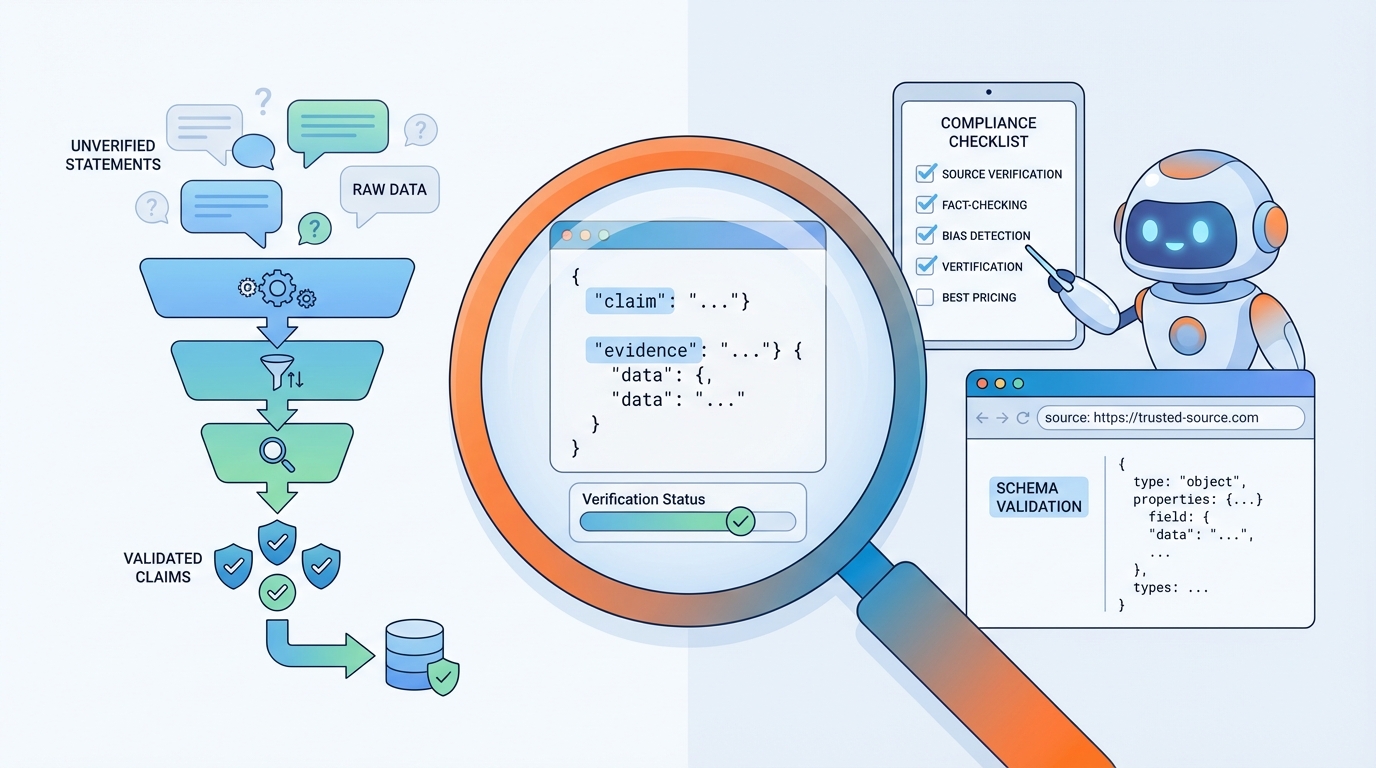
LLMs are used strictly for structuring and distillation, not for inventing facts:
- No claim without explicit source URLs
- Output in strictly validated JSON schemas
- Automatic filtering of unreferenced or inconsistent statements
- Clear separation between:
- what is stated (the claim),
- and where it comes from (the evidence)
This makes the system auditable, explainable and suitable for compliance-critical environments.
Technical architecture (high level)
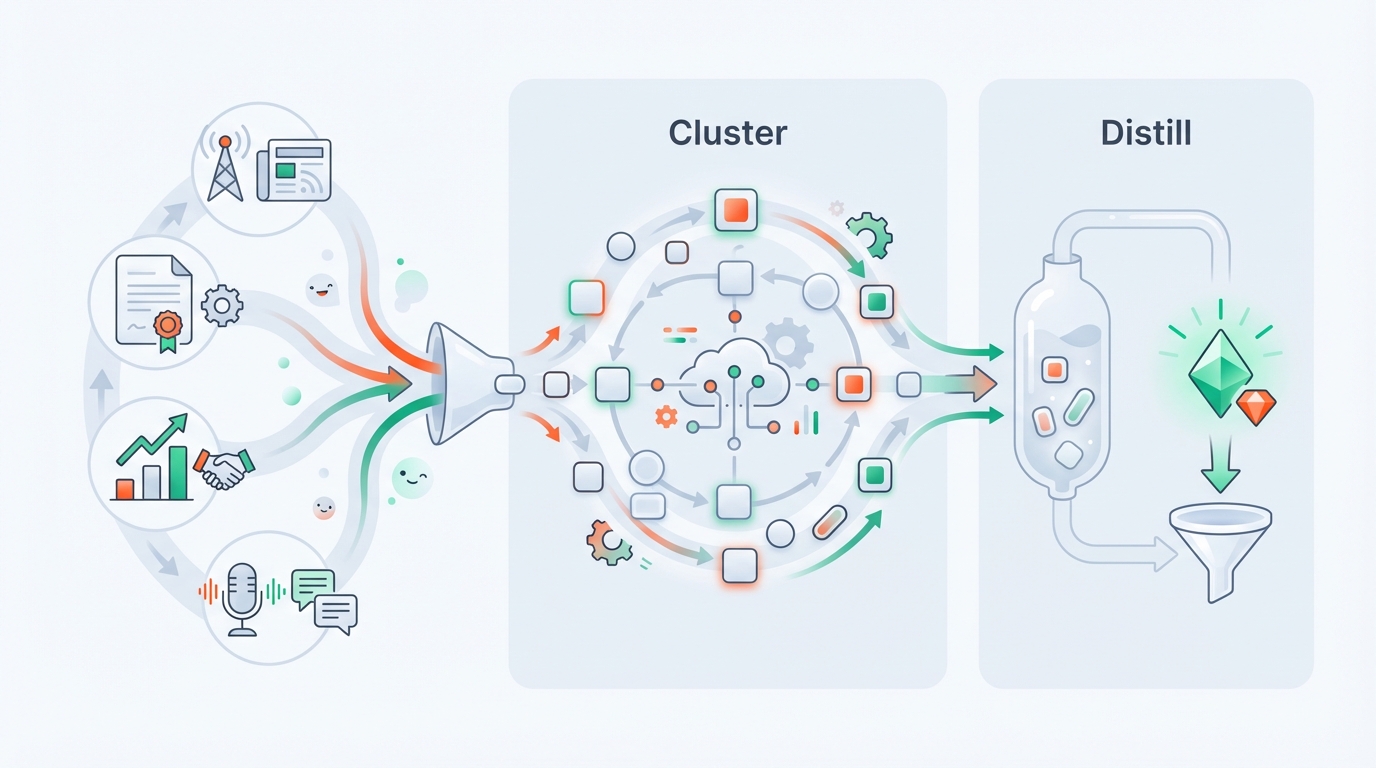
The platform is built as a modular pipeline:
-
Ingest
Collection and normalisation of:- news feeds
- regulatory and policy sources
- investor relations material
- audio/video transcripts
-
Cluster
Grouping by topic and time window. -
Distill
Extraction of atomic claims, validation and classification.
The web interface acts as an executive radar dashboard and an analyst evidence viewer, clearly separating signals from their source material.
Who is AI Radar for?
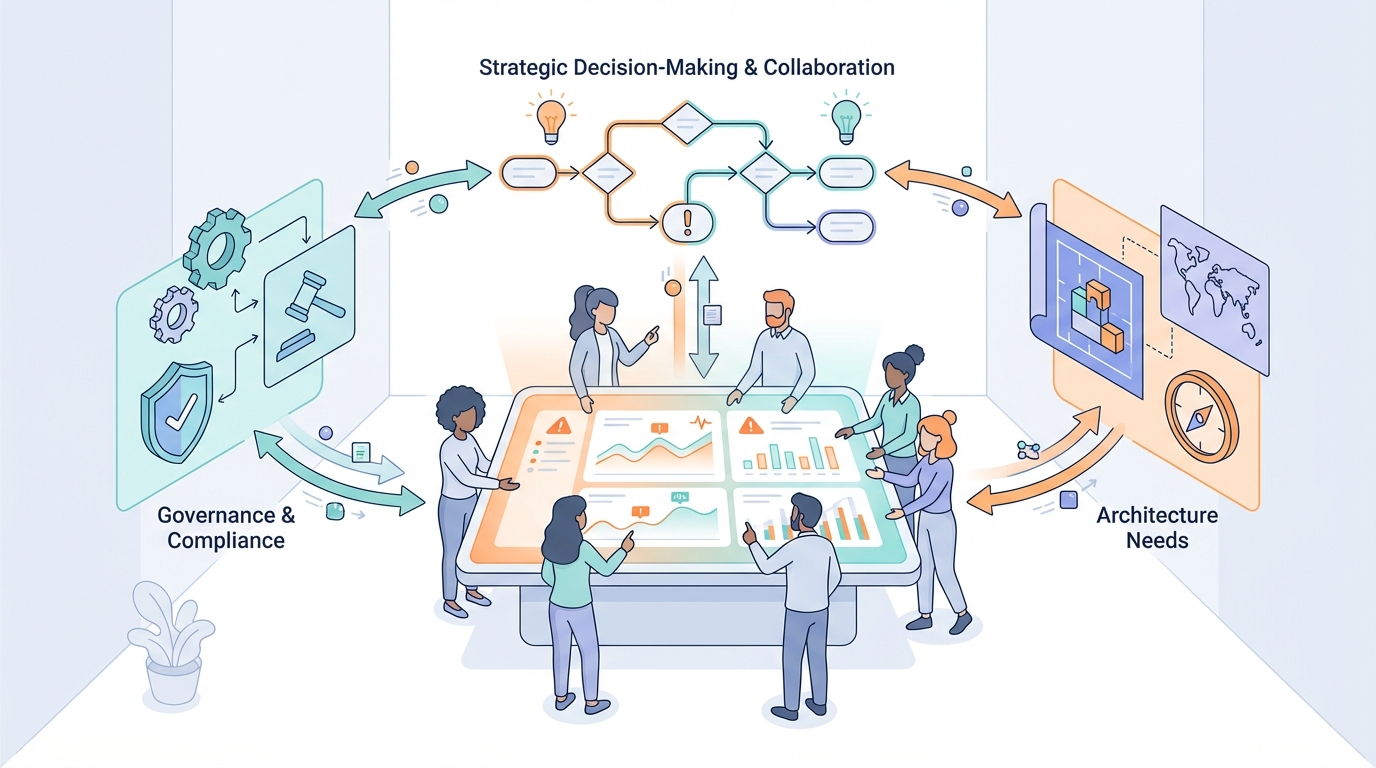
Board & Strategy
- Early warning on regulation, market shifts and technological change
- Daily or weekly executive briefings
- Trend and risk escalation
Compliance & Risk
- Continuous monitoring of regulators, legislation and security developments
- Full audit trail via the evidence layer
- Source-traceable decision support
Architecture & Technology
- Visibility into model evolution, infrastructure cost curves and vendor risk
- Signals instead of blog streams
From platform to instrument
Where classic AI news sites ask:
“What was published today?”
AI Radar answers:
“Which signals are strategically relevant now, how strong are they, and what evidence supports them?”
The system is available at:

Pilot & application
AI Radar can be deployed as:
- An executive briefing tool
- A compliance early-warning system
- A strategic monitoring layer
- An internal intelligence feed (Slack / Teams / email)
Every pilot starts from your strategic questions:
- which themes matter?
- which risks require early detection?
- which sources are authoritative?
- what escalation thresholds apply?
From there, we build a radar that does not merely inform, but detects, warns and substantiates.